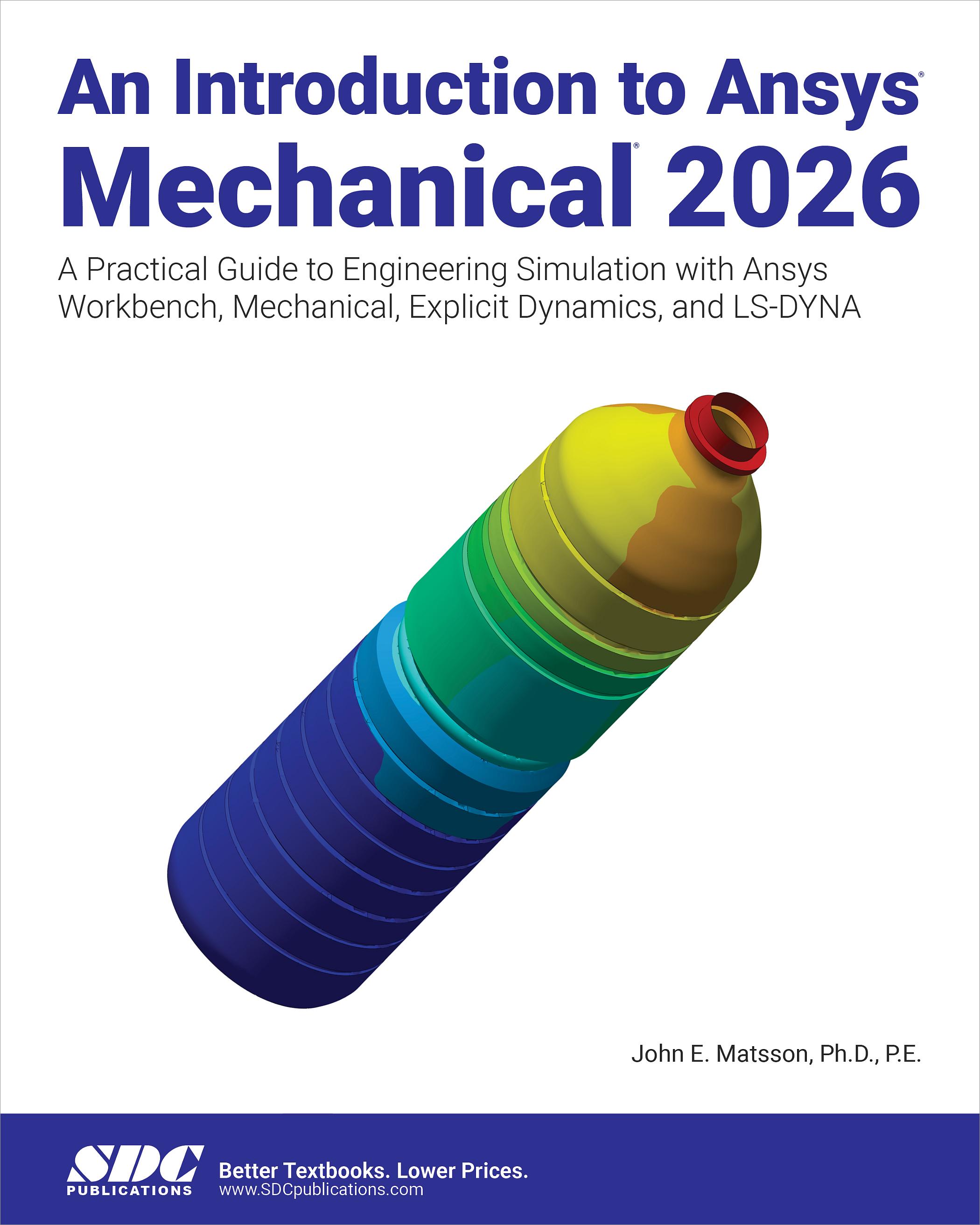
An Introduction to Ansys Mechanical 2026
A Practical Guide to Engineering Simulation with Ansys Workbench, Mechanical, Explicit Dynamics, and LS-DYNA
- Description
- Contents
- Downloads
- Instructor Resources
- Details
Description
Key Features
- Teaches new users how to perform finite element analysis with Ansys Mechanical 2026
- Uses practical engineering applications with detailed, step-by-step instructions
- Covers Ansys Workbench, DesignModeler, Static Structural, Explicit Dynamics, and LS-DYNA
- Features “WHY” Boxes that explain the reasoning behind key modeling decisions
- Progresses from basic structural analysis to nonlinear contact, fatigue, forming, and impact simulations
- Compares simulation results with engineering theory and experimental data
- Includes chapter exercises and multiple-choice diagnostic questions to reinforce learning
In Detail
How will a structure respond to a load? When will a component fail? What happens when a material bends, buckles, or absorbs an impact? An Introduction to Ansys Mechanical 2026 helps you investigate these questions through practical, step-by-step engineering applications that connect finite element analysis to physical behavior.
Beginning with Ansys Workbench, DesignModeler, and Mechanical, you’ll learn the complete simulation workflow: create geometry, define materials, generate meshes, apply loads and constraints, solve models, and interpret results. Early applications establish a foundation in structural analysis through balcony trusses, geodesic domes, aircraft frameworks, and traffic-light structures. As your skills develop, you’ll explore more demanding problems involving sheet-metal forming, fatigue, nonlinear contact, rubber deformation, impact testing, and PET bottle collapse.
Throughout the book, distinctive “WHY Boxes” explain the reasoning behind key modeling decisions. You’ll learn why a particular material model, mesh, boundary condition, or solver suits the problem and how those choices influence the results. Coverage of Static Structural, Explicit Dynamics, and LS-DYNA helps you understand how to select an analysis approach that fits the physics.
Engineering theory and comparisons with analytical solutions, experimental measurements, and published results give you practical ways to evaluate your simulations. You’ll examine stresses and deformations, interpret force-displacement curves, investigate fatigue life, and use plots and animations to communicate structural behavior. Chapter exercises and multiple-choice diagnostic questions reinforce both software skills and conceptual understanding.
Designed for undergraduate engineering students and practicing engineers developing their simulation skills, this text supports classroom instruction and independent study. No previous Ansys experience is required; a background in statics and mechanics of materials provides the foundation. Across 18 chapters, you’ll build experience tackling real-world engineering problems while learning not only how to follow a simulation workflow, but also how to develop the engineering judgment needed to choose appropriate methods, explain your modeling choices, and assess whether your results make physical sense.
Build practical simulation skills and the engineering judgment to use them confidently.
Table of Contents
- Introduction
- Balcony Truss
- Geodesic Dome
- Piper J3 Cub Fuselage
- Traffic Light
- Deep Drawing
- V-Bending
- Tensile Testing Lap-Joint
- Torsion Testing
- Charpy Testing
- R.R. Moore Rotating Beam Bending Fatigue
- Hand Casting
- Hertzian Contact Pressure
- Belleville Disc Spring
- Rubberband
- Brinell Hardness Testing
- PET Bottle Compression
- Sphere Penetration in Ballistic Gelatin
Index
Downloads
For additional information on downloading, unzipping, and using these files visit the downloads section on our Frequently Asked Questions page.
Instructor Resources
The following downloadable resources require that you are registered, logged in and have been authenticated as an instructor.

Product Details
| Publisher | SDC Publications |
| Authors | John E. Matsson Ph.D., P.E. |
| Media Types | Print Book, eBook |
| Primary Languages | English |
| Available | November 18, 2026 |
| User Level | Beginner - Intermediate |
| Pages | 500 |
| Binding | Paperback |
| Printing | Black and White |
| Print ISBN | 978-1-63057-878-7 |
| Print ISBN 10 | 1630578789 |