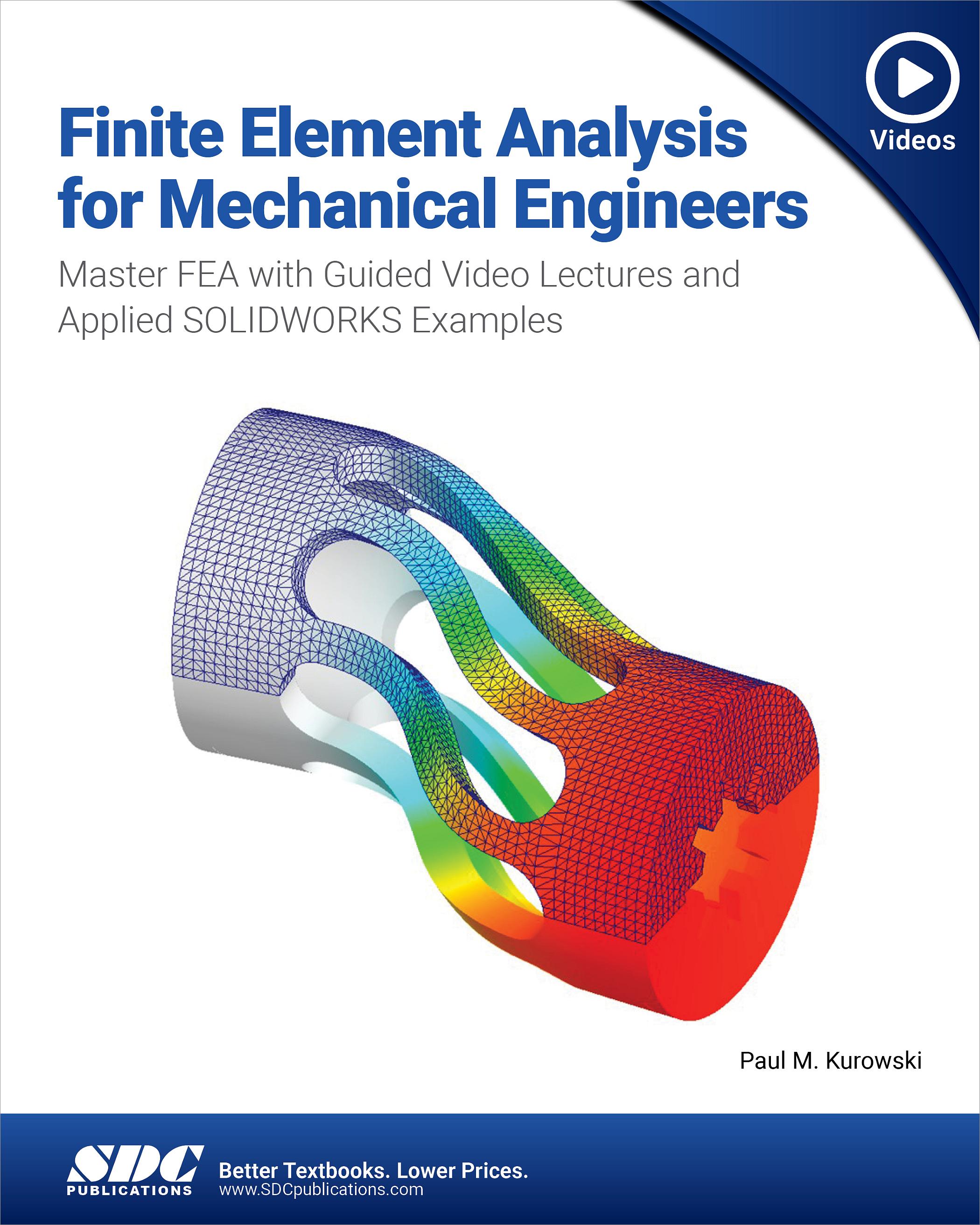
Finite Element Analysis for Mechanical Engineers
Master FEA with Guided Video Lectures and Applied SOLIDWORKS Examples
- Description
- Contents
- Downloads
- Instructor Resources
- Details
Description
Key Features
- Contains thirty video lectures with end-of-lesson self-assessment exams
- Covers static, modal, buckling, and nonlinear analyses along with essential theoretical background
- Uses step-by-step simulations using SOLIDWORKS Simulation to reinforce core FEA concepts
- Bridges the gap between FEA theory and practical, hands-on application
- Comes with instructor resources, including assignments, exams, PowerPoints and solved model files
- Flexible format for classroom, hybrid, or online instruction
- Builds practical, industry-ready Finite Element Analysis skills
In Detail
Finite Element Analysis for Mechanical Engineers is a complete, ready-to-teach video courseware package designed to help instructors deliver a rigorous, application-driven introduction to the Finite Element Method. Developed by renowned author Dr. Paul M. Kurowski, this course combines foundational theory with practical simulation exercises, creating a seamless path from first principles to real-world engineering analysis.
The course follows a 12 -13 week academic schedule typical of a one-semester course, guiding students through both the theory and practice of finite element analysis (FEA). The pedagogy is built on a carefully timed mix of theory and implementation. Students begin with the fundamentals like rigid body motion, degrees of freedom, discretization, and error control, before progressing into advanced topics such as nonlinear analysis, modal and buckling analysis, and convergence studies. Each lecture introduces key FEA concepts, immediately reinforced by guided simulations performed in SOLIDWORKS Simulation. While the course uses SOLIDWORKS Simulation for its practical examples, the focus remains on foundational FEA concepts. The skills acquired are not software-specific and can be implemented using any commercial FEA software.
Assignments and self-assessment quizzes ensure students not only learn how to perform analyses but also how to interpret and validate results, a crucial skill in engineering practice. By the end of the course, students can confidently implement FEA in the design process, evaluate model accuracy, and communicate simulation outcomes effectively.
Real Engineering Tools, Real Understanding
While the course demonstrates techniques using SOLIDWORKS Simulation, the analytical reasoning and problem-solving strategies it teaches are applicable to any commercial FEA software. Students gain a deep understanding of how elements, loads, and constraints interact, effectively bridging the gap between theoretical knowledge and industry application.
Designed for Flexibility and Modern Delivery
Instructors can teach this course face-to-face, online, or in hybrid formats. The modular design allows for self-paced study, instructor-led sessions, or a blended approach that combines recorded lectures with live labs. All videos include closed captions and audio descriptions for accessibility, and all models are provided in both SOLIDWORKS and CAD-agnostic formats.
This video courseware eliminates the barriers that often make simulation courses difficult to prepare and teach. Every component of the course has been professionally designed and classroom tested. Instructors gain access to ready-to-use presentations, detailed assignments, midterm and final exams, solved model files, and LMS-ready end-of-chapter quizzes. Each video is approximately 20-30 minutes long, allowing instructors to adopt the course as-is or integrate selected modules into an existing curriculum. For many institutions, adopting this video courseware is as simple as adopting a textbook, complete with an ISBN for easy bookstore ordering or inclusive access integration.
Key Learning Outcomes
Upon completing this course, students will be able to:
- Understand the essential theoretical foundations of FEA
- Implement FEA effectively in the engineering design process
- Evaluate and control numerical and modeling errors
- Perform a wide variety of analysis types, including linear static, modal, buckling, and nonlinear analyses
- Validate simulation results and communicate findings clearly
- Perform fast design iterations to find optimum solutions
- Translate skills learned to other FEA platforms
Why Instructors Choose This Course
- Professionally produced video lectures with clear, structured pacing
- Complete assessment materials with solutions and rubrics
- Minimal prep time required. It’s ready to teach out of the box
- Easy LMS integration for quizzes and assignments
- Meets all seven ABET student outcomes and learning objectives
Requirements
- Student Prerequisites: An academic course in Mechanics of Materials, first-year engineering mathematics (including matrix algebra and differential equations), and a basic familiarity with the SOLIDWORKS CAD interface.
- Software: Access to SOLIDWORKS Simulation 2024 or later. The Simulation add-in must have Static, Frequency, Buckling, and Nonlinear studies enabled. Access to Microsoft Excel is also required.
Finite Element Analysis for Mechanical Engineers is not just a set of lectures, it’s a complete educational solution that empowers instructors to deliver an engaging, modern, and technically sound FEA course with confidence.
Table of Contents
- Introduction
- Fundamental Concepts of FEA
- Static Analysis of a Plate – Part 1
- Static Analysis of a Plate – Part 2
- Static Analysis of a Plate Using Adaptive Solutions
- Static Analysis of an L-Bracket
- Modeling Techniques
- Verification of Validation of FEA Results
- 1D Elements – Part 1
- 1D Elements – Part 2
- 2D Truss Elements – Part 1
- 2D Truss Elements – Part 2
- 2D Truss Elements – Part 3
- 3D Elements
- 2D Elements
- Stress and Displacement Singularities
- Shell Elements
- Nonlinear Geometry Analysis – Part 1
- Nonlinear Geometry Analysis – Part 2
- Nonlinear Geometry Analysis – Part 3
- Nonlinear Material Analysis
- Nonlinear Material Analysis – Case Studies
- 1D Beam Elements – Part 1
- 1D Beam Elements – Part 2
- 3D Beam Elements
- Modal Analysis – Part 1
- Modal Analysis – Part 2
- Linear Buckling Analysis
- Nonlinear Buckling Analysis – Part 1
- Nonlinear Buckling Analysis – Part 2
Downloads
For additional information on downloading, unzipping, and using these files visit the downloads section on our Frequently Asked Questions page.
Instructor Resources
The following downloadable resources require that you are registered, logged in and have been authenticated as an instructor.
Product Details
| Publisher | SDC Publications |
| Authors | Paul Kurowski Ph.D., P.Eng. |
| Media Types | Videos |
| Primary Languages | English |
| Available | April 13, 2026 |
| User Level | Beginner - Intermediate |
| Media Duration | 10h 14m 39s |
| Binding | Video |
| Video Course ISBN | 978-1-63057-797-1 |