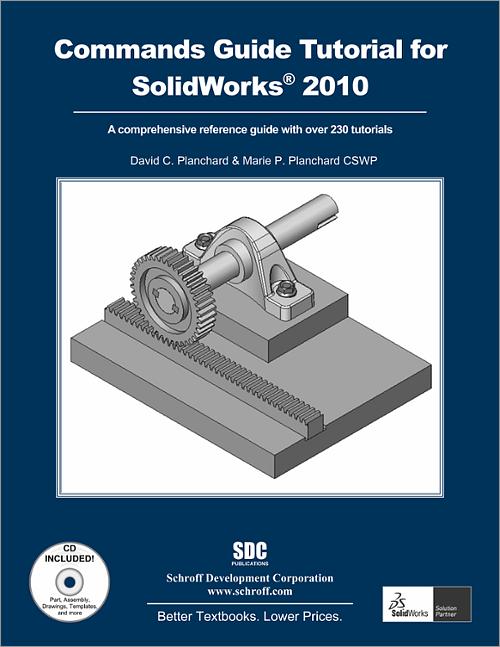

Commands Guide Tutorial for SolidWorks 2010
A Comprehensive Reference Guide with over 230 tutorials
- Description
- Contents
- Details
Description
Key Features
- A Comprehensive reference book for SolidWorks 2010
- Contains 230 plus standalone tutorials
- Starts with a basic overview of SolidWorks 2010 and it's new features
- Comes with a CD containing models of each tutorial's initial and final state
In Detail
The Commands Guide Tutorial for SolidWorks® 2010 is a comprehensive reference book written to assist the beginner to intermediate user of SolidWorks 2010. The book provides a centralized reference location to address many of the System and Document properties, FeatureManagers, PropertyManagers, ConfigurationManagers, and RenderManagers along with 2D and 3D Sketch tools, Sketch entities, 3D Feature tools, Motion Study, Sustainability Xpress, DFMXpress, SimulationXpress, Sheet Metal, PhotoView 360 and more.
Chapter 1 provides a basic overview of the concepts and terminology used throughout this book using SolidWorks 2010 software. If you are completely new to SolidWorks, you should read Chapter 1 in detail and complete Tutorial 1, Tutorial 2, and Tutorial 3 in the SolidWorks Tutorials.
If you are familiar with an earlier release of SolidWorks, you might still want to skim Chapter1 to get acquainted with some of the new commands, menus, and features that you haven't used; or you can simply jump to any section in any chapter.
Each chapter provides detailed PropertyManager information on key topics with individual stand alone short tutorials to reinforce and demonstrate the functionality and ease of the SolidWorks tool or feature. All models for the 230 plus tutorials are provided on the enclosed book CD with their solution (initial and final). Learn by doing, not just reading!
As you use this book, you will formulate the skills to create, modify and edit sketches and solid features. You will also learn the techniques to reuse features, parts and assemblies through symmetry, patterns, copied components, design tables, configurations and more.
The book is designed to complement the Online Tutorials and Online Help contained in SolidWorks 2010. The goal is to illustrate how multiple design situations and systematic steps combine to produce successful designs.
Table of Contents
- Introduction
- Quick Start
- SolidWorks System Options
- SolidWorks Document Properties
- Design Intent, Sketching and Sketch Entities
- Sketch Tools, Geometric Relations, and Dimensions/Relations Tools
- Extruded Boss/Base, Extruded Cut, Fillet and Cosmetic Features
- Revolved, Simple Hole, Hole Wizard and Dome Features
- Shell, Draft, and Rib Features
- Pattern and Mirror Features
- Sweep, Loft, Wrap and Flex Features
- Bottom up Assembly Modeling and more
- Top-Down Assembly Modeling and more
- 2D Drawings and eDrawings
- Sheet Metal
- PhotoView 360
- SolidWorks Design Library, Explorer, Toolbox and Measure tool
- SimulationXpress & SustainabilityXpress
Appendix
Index
Product Details
| Publisher | SDC Publications |
| Authors | David C. Planchard CSWP, 3DEXPERIENCE Edu Champ |
| Media Types | Print Book, eBook |
| Primary Languages | English |
| Published | November 30, 2009 |
| User Level | All Users |
| Pages | 738 |
| Binding | Paperback |
| Printing | Black and White |
| Print ISBN | 978-1-58503-548-9 |
| Print ISBN 10 | 1585035483 |